
Cycloidal vs Harmonic vs Traction Drive: Choosing a Robot Joint Reducer

Robot joints use three main categories of precision speed reducer: cycloidal drives, harmonic drives (strain wave gears) and traction drives. They differ in how torque crosses the transmission: rolling pins on a cycloid disc, a flexing toothed cup, or smooth rollers in traction contact. That single difference drives almost every trade-off downstream.
This comparison treats all three as what they are: distinct categories with distinct sweet spots. If you want the working principles first, we explain each in detail in the Archimedes Academy: how a cycloidal drive works, how strain wave gears work, and how the Archimedes Drive works.
The three operating principles in one paragraph each
Cycloidal drive. An eccentric input spins a cycloid disc that walks around a ring of pins. Many pins share the load simultaneously, which is why cycloidal reducers shrug off shock loads that damage other types. The eccentric motion needs counterweighting, and the pin engagement produces some torque ripple and noise.
Harmonic drive (strain wave gear). A wave generator flexes a thin-walled toothed cup (the flexspline) so its teeth engage a rigid ring gear at two zones. Two fewer teeth on the flexspline produce very high ratios in a very small package. The flexspline works by bending, every rotation, forever. That is both the trick and the fatigue limit.
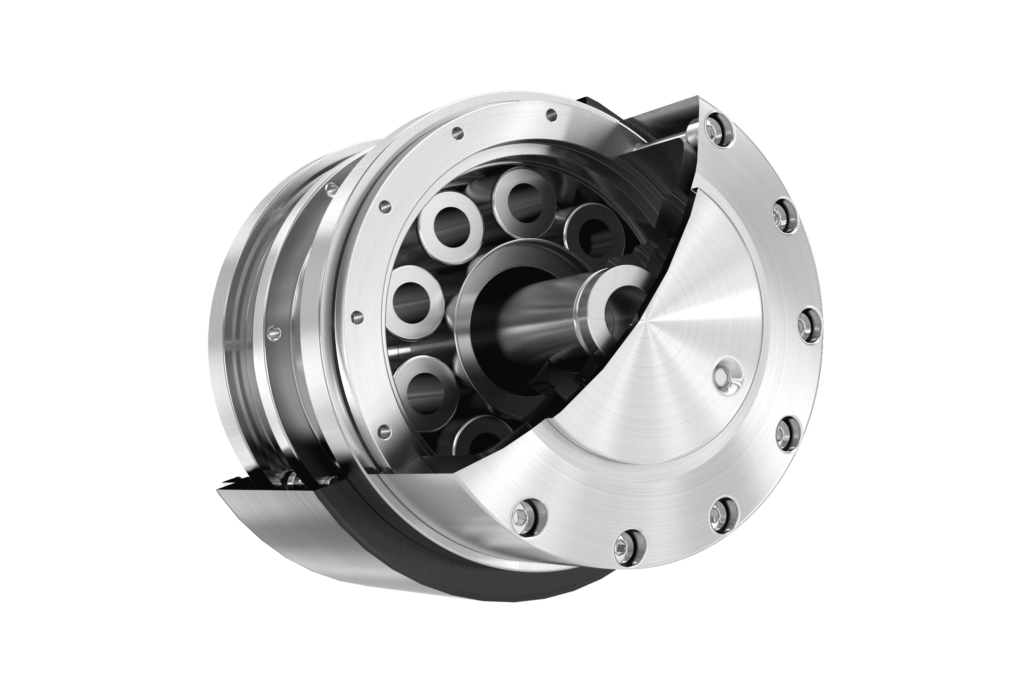
Traction drive. Smooth hardened rollers transmit torque through preloaded rolling contact. No teeth anywhere in the torque path. Backlash is zero by construction and stays zero, because there are no teeth to wear into clearance. The Archimedes Drive maintains the contact preload with loaded spring planet rollers, which is what gives it gear-class torque density, and it caps overloads by micro-slip: temporary sliding without meaningful damage.
Head-to-head comparison
| Property | Cycloidal | Harmonic (strain wave) | Traction (Archimedes Drive) |
|---|---|---|---|
| Backlash / lost motion | low (sub-1 arcmin in precision classes) | near zero new; develops up to ~1 arcmin with wear | 0.2 arcmin max, zero backlash for life |
| Ratio range | ~30:1 to 200:1 | ~50:1 to 160:1 | high single-stage ratios |
| Efficiency | ~80-90% | ~70-80% | 85% |
| Torsional stiffness | high | moderate (flexspline compliance) | high |
| Shock overload | excellent, progressive wear | flexspline fracture risk, sudden | micro-slip: temporary sliding, no meaningful damage |
| Noise | moderate (pin engagement) | low-moderate | low (no tooth engagement) |
| Size/weight at ratio | heavier at small sizes | best-in-class packaging | high torque density (75 Nm at 65 mm, 0.8 kg) |
| Failure mode | progressive, detectable | sudden (fatigue fracture) | progressive |
| Field history | decades (industrial robot standard) | decades (cobot standard) | commercial since the 2020s |
Where each one wins
Choose cycloidal for heavy industrial joints: base axes of large arms, high shock, high stiffness, where weight is secondary. This is why RV-style cycloidal units dominate industrial robot bases.
Choose harmonic when packaging rules: compact cobot joints and wrists where its ratio-per-volume is unmatched, loads are predictable, and scheduled replacement of wear parts is acceptable practice.
Choose traction when the joint must combine precision that lasts, quiet operation and collision tolerance: manipulation joints on humanoids and mobile manipulators working near people. It is the only category where the backlash number on the datasheet is still the backlash number after years of service, and its 85% efficiency beats strain wave gears outright. The honest caveat: fewer fielded years than the two incumbents.
The wear question nobody puts on the datasheet
Datasheets quote day-one backlash. Joints are bought for years. Tooth-based transmissions wear at every engagement surface, and precision planetary drives typically gain 1 to 3 arcmin of backlash over service life; strain wave gears develop up to about 1 arcmin. For a fixed welding fixture that may not matter. For a 7-DoF arm doing precision placement, backlash growth is accuracy decay on a schedule. Rolling traction contact does not have engagement surfaces to wear. The Archimedes Drive ships at 0.2 arcmin maximum lost motion and stays there: zero backlash for life. Ask every vendor for backlash-over-life data, including us.
FAQ
Which reducer is best for a humanoid robot joint?
There is no single answer. Legged platforms often mix types per joint: shock-tolerant cycloidal or QDD at hips and knees, compact harmonic at wrists. Wheeled humanoids doing manipulation near people weight silence, stable precision and collision tolerance higher, which favours traction drives in the arm chain. See our wheeled humanoid actuator guide.
Is a harmonic drive zero backlash?
When new, effectively yes. The flexspline preload eliminates clearance. Wear changes that over service life, typically up to about 1 arcmin.
Why do industrial robots still use cycloidal reducers?
Proven ruggedness, high stiffness and decades of supplier maturity. For 200 kg payload arms bolted to concrete, those outweigh noise and weight.
Are traction drives proven enough for production robots?
The rolling-contact physics has decades of research history, including NASA’s multiroller programs. What is new is the torque density that makes it joint-ready, enabled by loaded spring planet rollers. Run your own lifecycle tests as you would for any joint component. What you are testing for is different though: there is no flexspline to fatigue and no teeth to wear, which removes the two failure modes those tests usually chase.